Afforestation of the West Temaenian Littoral
The DispossessedThe Afforestation of the West Temaenian Littoral was a major Anarresti restoration project that sent planting crews into the Dust to re-establish forest on land dried by millennia of drought. Conducted over two years in the fifteenth decade of the Settlement of Anarres, it employed nearly eighteen thousand people. Its modest visible result—a faint green veil on desert terraces—joined ecological repair to the novel’s account of shared labor, environmental vulnerability, and the difficult work of reversing damage across generations.
Landscape and ecological purpose
The project addressed a stark imbalance in Anarres’s geography. The fertile communities of the Southeast occupied only a narrow strip beside the sea; inland and westward, across the broad plains of the Southwest, the Dust extended around a few isolated mining towns. That expanse was not barren by origin: in an earlier geological era it had been covered by holum forest, the planet’s ubiquitous dominant plant genus. A hotter, drier climate and millennia of drought killed the trees and reduced the soil to fine grey dust, which winds piled into barren, dune-like hills.
The planting effort therefore aimed not simply to put trees into a desert but to restore fertility to a damaged landscape. Anarresti hope rested on the possibility that land once shaded by forest might again support dark, rich soil. The undertaking made ecological repair a long, collective process: the harm had accumulated over millennia, while the work proceeded through human crews, seedlings, and years of labor.
The work and its costs
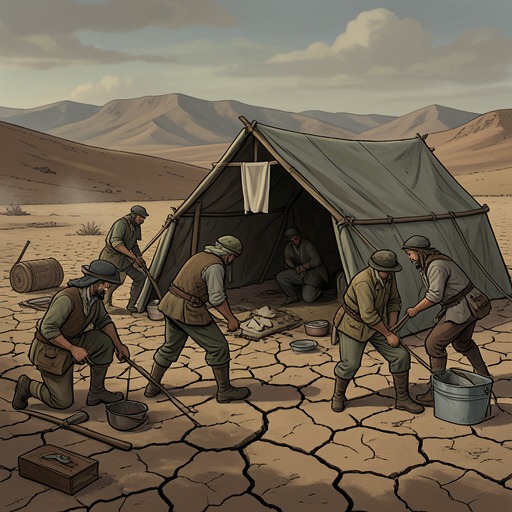
Seedlings were raised in the Green Mountains, where rainfall reached as much as forty inches a year, and transported from the Northeast to the planting crews. Shevek worked with a crew planting thousands of the small trees in the Dust. At night, people in the project camps coughed; during the day, they coughed less because they were busy. The fine, dry dust obstructed their breathing, making the landscape both the obstacle they endured and the ground they hoped to restore.
The project’s scale became visible at the end of the second year. Fifty crews drove away in flatbed trucks, looking back at the pallid desert curves and terraces. They saw a very faint mist of green: a light veil of life laid over dead land. The crews cheered and sang from truck to truck, and Shevek was moved by the sight. The result was not a mature forest or a completed recovery, but the first visible sign that sustained collective effort might alter the Dust’s future.
Meaning within Anarres’s wider conditions
For Shevek, the replanting suggested a connection between ecological restoration and Causative Reversibility, an idea in temporal physics that he regarded as an intimate, tacit element of Odonian thought. He considered writing about the relationship between Odo’s ideas, temporal physics, and the problem of ends and means, though at eighteen he judged himself not yet knowledgeable enough to do so. The project thus linked physical work on the land with his emerging scientific questions: what has been caused may, through action, be answered or counteracted.
That hope existed alongside Anarres’s material dependence on a precarious environment. The planet’s holum plants supplied food, clothing, and other necessities, while water during the later drought was directed toward keeping plants alive. The Dust project’s ambition to renew an old forest consequently belonged to a broader struggle over land, water, labor, and survival. The novel also situates Anarres within an unequal exchange with Urras: freighters brought fossil fuels, machine parts, and other supplies, while carrying away metals and uranium from what was, in economic terms, a mining colony. Against that extractive relation, afforestation represented a different use of collective labor—not the removal of mineral wealth, but an attempt to give damaged land back its capacity to sustain life.
Legacy and narrative significance
The project’s achievement remains deliberately partial. The crews leave behind only a faint green trace, and the coughing, arid conditions make clear that intention alone cannot erase the consequences of a changed climate. Yet the image of the planted trees holds together hope and limitation: restoration is possible, but it demands time, shared work, and a willingness to bear present costs for a future not yet secured.
In the larger narrative, the afforestation episode gives physical form to the principle that ends and means are connected. The forest cannot be restored by declaration; it must be planted, crew by crew, in the very dust that frustrates the work. The project’s green veil is therefore both an environmental beginning and a social one, showing Anarresti solidarity at work while exposing how ecological vulnerability reaches into the bodies and daily labor of those who undertake repair.